Generation Y + Generation Z: Are You About to Lose Your Job to AI or Gain an Unfair Advantage?
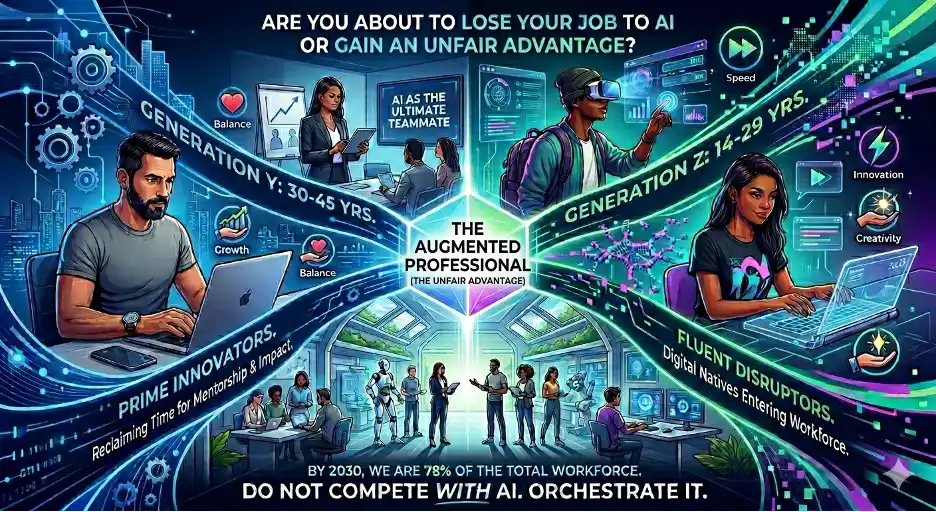
Generation Y, better known as Millennials, were born between 1981 and 1996. Today, they are 30 to 45 years old, right in the middle of their prime earning and family-building years. They came of age as the internet exploded and social media reshaped culture, business, and communication. There are roughly 74 million Millennials in the U.S., representing the single largest share of today’s workforce.
Generation Z, or iGen, spans those born between 1997 and 2012. They are currently 14 to 29 years old, with roughly 71 million in the U.S. alone. The older cohort is already building careers and moving into management, while the younger group is just entering the system.
Put those two generations together and you get roughly 67% of today’s workforce. By 2030, that number is projected to approach nearly 78%. That’s not just a demographic shift. That’s a complete rewrite of how work operates.
At the same time, these generations are entering adulthood and building careers during one of the most disruptive periods in modern economic history – an era defined by rapid automation, economic volatility, layoffs, technological acceleration, and skills becoming obsolete faster than ever before.
The anxiety around AI is not irrational. It’s completely understandable. I’ve spoken with young professionals who already feel like the ground is shifting beneath them. Many managers privately admit they are both excited and deeply uneasy about what’s coming.
But here is where much of the public conversation gets it wrong: AI is not replacing entire jobs overnight. It is replacing tasks inside jobs. That distinction matters more than almost anything else.
The $15 Trillion Shift
According to estimates from PwC AI could contribute as much as $15.7 trillion to the global economy by 2030. Meanwhile, analysis from Goldman Sachs suggests AI could expose the equivalent of 300 million full-time jobs to automation-related disruption.
Those headlines sound terrifying. But the deeper reality is more nuanced.
Jobs rarely disappear all at once. Instead, portions of jobs begin to shift, compress, or become automated. The repetitive and procedural components get absorbed by AI, while the human-centered components become more valuable.
The people who struggle most will not necessarily be those with the least education. They will be those who remain static while the world changes around them. The people who adapt fastest are probably going to do very well. And frankly, most companies are still figuring this out in real time.
Where AI Hits Hardest
AI’s greatest strength is simple: It can process, analyze, and compare more information in seconds than a human could in a lifetime – millions of documents, massive datasets, and entire systems of knowledge.
Humans get tired. AI does not.
That is why AI hits hardest in work that is:
- digital
- repeatable
- structured
- and volume-driven
If your role is primarily built around:
- processing information
- generating reports
- summarizing data
- routine analysis
- repetitive digital workflows
…AI is already reshaping your industry.
This is why fields such as:
- administrative support
- customer service
- routine software development
- basic financial analysis
- marketing content production
- and data-heavy office work
are experiencing rapid transformation.
The common denominator is what might be called “information transformation” work- taking information in, organizing it, processing it, and pushing it back out.
That’s exactly where AI thrives.
What AI Does Extremely Well and What It Cannot Do
Strip away the hype, and AI comes down to several core strengths:
- It processes enormous amounts of information
- It recognizes patterns humans often miss
- It operates at extraordinary speed and scale
- It delivers consistency without fatigue
- It generates content and solutions almost instantly
AI thrives where work is data-driven, repeatable, and scalable. But that’s only half the story. AI also has very real limitations.
It cannot:
- build genuine human relationships
- understand emotional nuance
- exercise moral judgment
- navigate complex social dynamics
- lead people through uncertainty
- or take responsibility for outcomes
AI can generate answers. It cannot own consequences. That distinction matters enormously.
Leadership requires:
- trust
- accountability
- judgment under pressure
- and the ability to navigate ambiguity when there is no clear right answer
Those remain deeply human domains. AI can suggest a course of action. It cannot stand behind that decision when lives, money, careers, or reputations are on the line.
The Emerging “Unfair Advantage”
The future does not belong to people who compete directly against AI on execution. The future belongs to the Augmented Professional -people who understand how to combine human judgment with AI leverage.
This is the Millennial manager who uses AI to automate reporting and administrative work so more time can be spent mentoring teams and making strategic decisions.
It is the Gen Z designer who uses AI to generate 50 creative concepts in minutes, then applies human taste, instinct, and emotional understanding to identify the one that will resonate. It is the entrepreneur who uses AI to compress months of work into days while still maintaining human direction and oversight. That is where the unfair advantage lives.
The New Careers AI Is Creating
According to the World Economic Forum, while millions of jobs may be displaced over the coming decade, even more new roles are expected to emerge.
Many of these new careers sit at the intersection of:
- technology
- business
- and human judgment
We are already seeing demand for:
- AI Workflow Architects
- Prompt and Interaction Designers
- AI Product Managers
- Ethics and Governance Specialists
- Human–AI Team Managers
- Synthetic Media Producers
- AI Auditors
- Data Curators and Trainers
- Personal AI Trainers
- AI-Augmented Educators and Coaches
These are not purely technical roles.
They reward people who can combine:
- domain expertise
- critical thinking
- communication skills
- leadership
- and AI fluency
In other words:
The winners in the AI era will not simply be the best coders or fastest producers.
They will be the people who know how to direct systems, guide decisions, and create meaning while AI handles scale and execution.
The Real Opportunity for Generation Y and Generation Z
Generation Y and Generation Z are uniquely positioned for this moment.
They are digital natives.
They grew up adapting to technological change.
They are already comfortable operating across digital ecosystems.
But adaptability alone is not enough.
The new playbook requires four things:
- Learn how to use AI as a multiplier rather than fearing it as a replacement.
- Double down on uniquely human strengths like leadership, empathy, judgment, and creativity.
- Build hybrid expertise by combining AI fluency with real industry knowledge.
- Stay relentlessly curious, because the half-life of skills is shrinking rapidly.
The reality is straightforward. AI is not coming for your job. It is coming for the automatable parts of your job.
The upgraded version – the one built around judgment, creativity, leadership, and direction – still belongs to humans.
Final Thought
As we move toward 2030, the real divide will not be between people who use AI and people who do not.
It will be between those who passively react to technological change and those who learn to direct it.
Generation Y and Generation Z are not simply inheriting the future of work. They are the generations that will define it.
The only real question is this: Will you spend the next decade competing against AI or learning how to lead with it?
Read More