Generation Y + Generation Z:  Are You About to Lose Your Job to AI or Gain an Unfair Advantage?

Generation Y + Generation Z: Are You About to Lose Your Job to AI or Gain an Unfair Advantage?

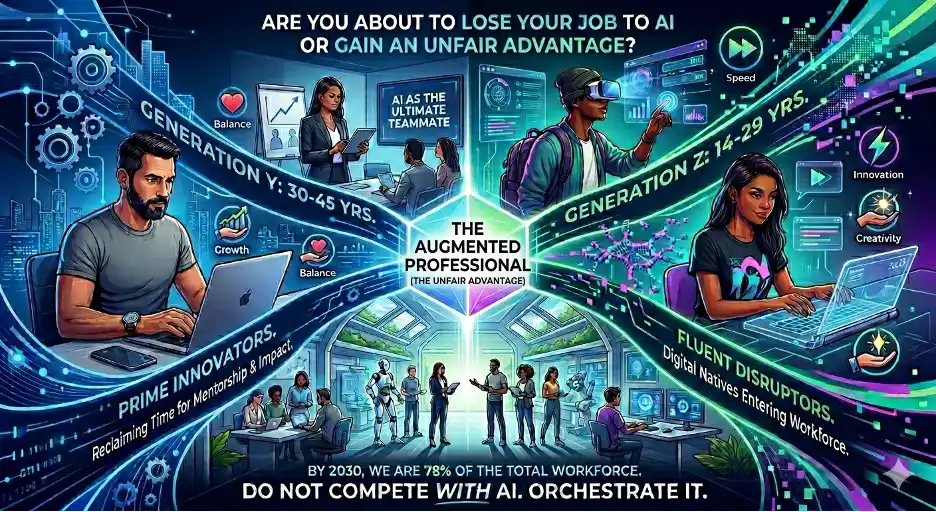
Generation Y, better known as Millennials, were born between 1981 and 1996. Today, they are 30 to 45 years old, right in the middle of their prime earning and family-building years. They came of age as the internet exploded and social media reshaped culture, business, and communication. There are roughly 74 million Millennials in the U.S., representing the single largest share of today’s workforce.

Generation Z, or iGen, spans those born between 1997 and 2012. They are currently 14 to 29 years old, with roughly 71 million in the U.S. alone. The older cohort is already building careers and moving into management, while the younger group is just entering the system.

Put those two generations together and you get roughly 67% of today’s workforce. By 2030, that number is projected to approach nearly 78%. That’s not just a demographic shift. That’s a complete rewrite of how work operates.

At the same time, these generations are entering adulthood and building careers during one of the most disruptive periods in modern economic history – an era defined by rapid automation, economic volatility, layoffs, technological acceleration, and skills becoming obsolete faster than ever before.

The anxiety around AI is not irrational. It’s completely understandable. I’ve spoken with young professionals who already feel like the ground is shifting beneath them. Many managers privately admit they are both excited and deeply uneasy about what’s coming.

But here is where much of the public conversation gets it wrong: AI is not replacing entire jobs overnight. It is replacing tasks inside jobs. That distinction matters more than almost anything else.

The $15 Trillion Shift

According to estimates from PwC AI could contribute as much as $15.7 trillion to the global economy by 2030. Meanwhile, analysis from Goldman Sachs suggests AI could expose the equivalent of 300 million full-time jobs to automation-related disruption.

Those headlines sound terrifying. But the deeper reality is more nuanced.

Jobs rarely disappear all at once. Instead, portions of jobs begin to shift, compress, or become automated. The repetitive and procedural components get absorbed by AI, while the human-centered components become more valuable.

The people who struggle most will not necessarily be those with the least education. They will be those who remain static while the world changes around them.  The people who adapt fastest are probably going to do very well.  And frankly, most companies are still figuring this out in real time.

Where AI Hits Hardest

AI’s greatest strength is simple: It can process, analyze, and compare more information in seconds than a human could in a lifetime – millions of documents, massive datasets, and entire systems of knowledge.

Humans get tired. AI does not.

That is why AI hits hardest in work that is:

  • digital
  • repeatable
  • structured
  • and volume-driven

If your role is primarily built around:

  • processing information
  • generating reports
  • summarizing data
  • routine analysis
  • repetitive digital workflows

…AI is already reshaping your industry.

This is why fields such as:

  • administrative support
  • customer service
  • routine software development
  • basic financial analysis
  • marketing content production
  • and data-heavy office work

are experiencing rapid transformation.

The common denominator is what might be called “information transformation” work- taking information in, organizing it, processing it, and pushing it back out.

That’s exactly where AI thrives.

What AI Does Extremely Well and What It Cannot Do

Strip away the hype, and AI comes down to several core strengths:

  • It processes enormous amounts of information
  • It recognizes patterns humans often miss
  • It operates at extraordinary speed and scale
  • It delivers consistency without fatigue
  • It generates content and solutions almost instantly

AI thrives where work is data-driven, repeatable, and scalable. But that’s only half the story. AI also has very real limitations.

It cannot:

  • build genuine human relationships
  • understand emotional nuance
  • exercise moral judgment
  • navigate complex social dynamics
  • lead people through uncertainty
  • or take responsibility for outcomes

AI can generate answers. It cannot own consequences. That distinction matters enormously.

Leadership requires:

  • trust
  • accountability
  • judgment under pressure
  • and the ability to navigate ambiguity when there is no clear right answer

Those remain deeply human domains. AI can suggest a course of action. It cannot stand behind that decision when lives, money, careers, or reputations are on the line.

The Emerging “Unfair Advantage”

The future does not belong to people who compete directly against AI on execution. The future belongs to the Augmented Professional -people who understand how to combine human judgment with AI leverage.

This is the Millennial manager who uses AI to automate reporting and administrative work so more time can be spent mentoring teams and making strategic decisions.

It is the Gen Z designer who uses AI to generate 50 creative concepts in minutes, then applies human taste, instinct, and emotional understanding to identify the one that will resonate. It is the entrepreneur who uses AI to compress months of work into days while still maintaining human direction and oversight. That is where the unfair advantage lives.

The New Careers AI Is Creating

According to the World Economic Forum, while millions of jobs may be displaced over the coming decade, even more new roles are expected to emerge.

Many of these new careers sit at the intersection of:

  • technology
  • business
  • and human judgment

We are already seeing demand for:

  • AI Workflow Architects
  • Prompt and Interaction Designers
  • AI Product Managers
  • Ethics and Governance Specialists
  • Human–AI Team Managers
  • Synthetic Media Producers
  • AI Auditors
  • Data Curators and Trainers
  • Personal AI Trainers
  • AI-Augmented Educators and Coaches

These are not purely technical roles.

They reward people who can combine:

  • domain expertise
  • critical thinking
  • communication skills
  • leadership
  • and AI fluency

In other words:

The winners in the AI era will not simply be the best coders or fastest producers.

They will be the people who know how to direct systems, guide decisions, and create meaning while AI handles scale and execution.

The Real Opportunity for Generation Y and Generation Z

Generation Y and Generation Z are uniquely positioned for this moment.

They are digital natives.
They grew up adapting to technological change.
They are already comfortable operating across digital ecosystems.

But adaptability alone is not enough.

The new playbook requires four things:

  1. Learn how to use AI as a multiplier rather than fearing it as a replacement.
  2. Double down on uniquely human strengths like leadership, empathy, judgment, and creativity.
  3. Build hybrid expertise by combining AI fluency with real industry knowledge.
  4. Stay relentlessly curious, because the half-life of skills is shrinking rapidly.

The reality is straightforward. AI is not coming for your job. It is coming for the automatable parts of your job.

The upgraded version – the one built around judgment, creativity, leadership, and direction – still belongs to humans.

Final Thought

As we move toward 2030, the real divide will not be between people who use AI and people who do not.

It will be between those who passively react to technological change and those who learn to direct it.

Generation Y and Generation Z are not simply inheriting the future of work. They are the generations that will define it.

The only real question is this: Will you spend the next decade competing against AI or learning how to lead with it?

Read More


Anthologies: Ensuring a Successful Author Collaboration

Anthologies: Ensuring a Successful Author Collaboration

Authors have been working together on anthologies for centuries. Why?

  • Shared workload – multiple contributors rather than one author writing an entire book on their own.
  • Benefit from varied experiences and talents.
  • Multiple authors typically mean multiple audiences – and multiplied people working on marketing the book.
  • Anthologies can be a great way for a group of authors to “share” or “swap” audiences to grow their readership.

My friend and client, Fred Stuvek Jr., has recently written an anthology featuring 15 contributors – no mean feat! Since Fred and I have been working on the marketing piece of his publishing plan together, I had a front row seat to how he worked with 15 other collaborators to create The Experience of Leadership. I was so impressed with the way he led this project, that I asked for his advice on how to ensure a successful collaboration when working on an anthology. Enjoy his great advice and tips below.

– Keri-Rae Barnum

The Art of Author Anthologies: How to Ensure a Successful Collaboration

The reasons for me wanting to write The Experience of Leadership are detailed in the introduction of the book. I chose an anthology format for The Experience of Leadership to highlight the principles and practices of successful leaders across the spectrum, asserting that the reader would find this approach informative and inspiring. For anyone who is considering using such a format, here are the issues which are central to a successful collaboration, and how I addressed them.

1. Desired outcome

An anthology was the best path to the desired outcome of my book – I began with the end in mind.

“I wanted to cut through the generalities and nostrums about leadership and dive into the nitty-gritty details of how to obtain the experience and skills that great leaders display and aspiring leaders can learn from. So, I assembled a broad, diverse group of individuals who have attained success in various arenas in order to understand how their leadership journey unfolded—piece by piece.” – The Experience of Leadership

To read more on why I chose this format, read the full book introduction.

2. Leadership

While some book anthologies will have an equal workload among authors, others will be the project of a single author with limited roles and expectations from the other contributors. Regardless of format, projects work best when there is a leader in place. Someone leading the charge in curating content – often writing additional content – and to organize each step of the process and keep things moving along.

3. Team

I had specific criteria in mind when choosing my writing team as I wanted participants who were actively involved in leadership development and in high profile leadership positions. I sought those with a range and diversity of experience in three fields: military, education and sports.

4. Clarity

When inviting other authors to work on The Experience of Leadership, I was very specific as to the goal of the project, what issues we wanted to address, and what topics to consider. At the same time, each participant understood he or she had the latitude to address any topics or make any recommendations they believed were instrumental in the leadership development process.

5. Communication

Throughout the process I kept everyone informed as to our status on attaining our objectives or milestones. Routine updates were sent so that everyone was fully informed. There were no surprises.

6. Transparency

As we went through the multitude of steps required to complete the project and the book, I was completely transparent. I solicited their feedback on a range of issues, both large and small, to ensure all views were considered. I welcomed the contrary opinion, and even constructive criticism, understanding that any comments made were done so with the purpose of delivering the highest quality product possible.

7. Respect

There was mutual respect amongst all parties, which was conducive to an open, sometimes, free-wheeling exchange of opinions as we went through the necessary iterations which are essential to continual improvement.

8. Humility

No one has all the answers and getting advice or help from those you collaborate with is important, imbues trust, and fosters a closer collaboration as everyone is involved and has a say in what is going on. Check your ego at the door, understanding that asking questions and getting advice is not a sign of weakness, and is quite the opposite. For those of you who are in the midst of a collaborative project, or considering a collaborative approach, keep the above points in mind. You will discover it is a very practical and worthwhile approach to generate views and advice which will be welcomed by your readers. Good luck, and if anyone has any questions or would like to brainstorm on a project you have in mind, do not hesitate to leave a comment below or contact me directly.

Read More
Lessons Learned from my Military Experience

Lessons Learned from my Military Experience

There is tremendous value and benefit to having military experience.  It has had a lasting impact on me and I am thankful for the experience. I learned a number of lessons and values which had a direct impact on my ability to be successful in later endeavors and throughout life.  Chief amongst them are:

Discipline – Discipline is the soul of your journey; it is one of the most important traits required for success in whatever you strive to accomplish.  Discipline gives you the will to take the necessary actions to improve yourself, the courage to face your fears, and the self-control to stick to a regimen or a plan.  A lack of discipline results in excuses and distracts you from doing what is necessary to complete the mission and be successful.  In the military, the consequences can literally be the difference between life and death as if you do not carry through you jeopardize your team or unit.  While the consequences are different, the same thing applies in the business world.  If you don’t have the discipline to push through and the self-control to do what is required of you to do as part of the bigger picture, those lapses will result in compromised performance.

Teamwork – All teams consist of groups of individuals.  While the individuals may be highly skilled and capable, team success is predicated on how the individual capabilities of the team can be harnessed so they function as a cohesive unit in the most effective and efficient manner possible. In the military, there is a lot of bonding that goes on through basic training exercises, drills, and maneuvers. Everyone has a specific role and each individual is held accountable for their work.  However, the focus is on unit performance versus individual performance, with everyone having a shared sense of commitment and duty since everyone is part of a greater cause.  This process and commitment results in an ethos with a set of core values and beliefs that promotes camaraderie and a sense of interdependence. Everyone has each other’s back with the character and integrity to maintain the highest standards possible in the interest of the greater good.  Just like the military, life is a team sport, and those same lessons carry over.

Planning – You spend a lot of time in the military training and planning.  First and foremost is clarity, or in other words, a clearly defined mission.  The goals and actions need to be aligned, everyone needs to understand what needs to be done, what their role is, and why it is important.  The why is important since a greater understanding yields a stronger belief which reinforces the commitment.  You spend a great deal of time reviewing and rehearsing the plan, while at the same time looking at three scenarios – what is the likely outcome, what is the worst case, and what is the best case.  You then develop contingency plans based on these projected outcomes since things do not always go as planned and there can likely be unintended consequences that you have to deal with.  Throughout this planning you are transparent and respect other people’s views and input, especially the critics, as it is only through them that you can improve.  As you train and the plan evolves everyone understands their role based on various scenarios, which is of critical importance since as things unfold and if the situation deteriorates you need to ensure everyone can quickly react and adapt as circumstances dictate.

Adversity – How someone deals with adversity could be viewed as the single biggest challenge in their life.  The true test of character is not how well someone behaves when things are going well, but how one responds when things don’t work out and problems occur.  These adverse circumstances are valuable life lessons as you learn from them and do not make the same mistakes again.  This also helps to build resiliency and develops your ability to maintain your resolve and determination through trying circumstances, adapt as required, and handle the associated stressors.  In the military one is continually faced with adverse circumstances such as extended deployments, a mission that may not be unfolding according to plan, not having access to resources that may be required, operating in a sleep deprived condition, and so forth. In the military you develop the ability to see things through. You are entrusted with a mission that is of signal importance. When faced with challenges or complex circumstances it is incumbent upon you to make it work since the cost of failure can have far reaching consequences.

Leadership – There is no better training grounds for leadership than military service. Leading a military unit is a complicated and rigorous process and one needs a range of tools to be effective. The kind of responsibility and accountability thrust upon you gives you the opportunity to learn to lead in a variety of arenas with a spectrum of individuals. Most of the people who join the military do so for intrinsic not extrinsic reasons, thus it is important to be proficient in those skills and areas that provide inspiration and motivation to the team. You learn to be disciplined, consistent, ethical and respectful while understanding that there is no one size fits all.  Consequently, you learn what I would characterize as adaptive leadership as you understand that not every person responds in the same way, every situation has its own distinct set of challenges, and you as their leader are center stage and held accountable. Understanding this, you also demonstrate the trust you have in your unit by empowering team members, ensuring you maximize unit performance by proper alignment since the entire team is only as strong as the weakest link.

Read More
Looking Toward the Future? Five Ways to Choose the Right Career Path

Looking Toward the Future? Five Ways to Choose the Right Career Path

Deciding what you want to do with your life and your career is not revolutionary – it is evolutionary. Since you will spend much of your life at work you owe it to yourself to understand what inspires you and motivates you, and match those beliefs with your personality, skill set, interests, and values. Only then will you be able to optimize your prospects for success, fulfillment, and happiness.

Deciding on a career is part art and part science. It is an art because it is personal. It is a science because it is a five-step process requiring assessment, investigation, alignment, career choice, and company choice.

Below are those five steps, which, if taken seriously, I believe will help you choose the career path that is right for you.

Assess

Conducting a self-assessment enhances your ability to identify your interests, skills, personality, and values.

Interests are what you enjoy doing. Skills are what you do best or what you can acquire. Personality is the set of characteristics that determines your behavior. Values are what is important to you.

Ask yourself, “What do I enjoy doing?  Where have I excelled?” Conversely, admitting what you do not enjoy strengthens and balances your assessment process.

Analyze your skills and how they fit your interests.

Understanding your personality and choosing a career that fits will improve your prospects for performance and job satisfaction.

A figure, viewed from behind, is look at doors in the clouds.

Investigate

Investigate and explore your specific areas of interest. Research sources include the web, books, journals, career fairs, and industry professionals. Take career-specific tests as a means to further identify targeted professions. Join various clubs, do volunteer work, or get a summer job.

While in college, research your degree. Look at the careers others have pursued, and talk with graduates to get the pros and cons of the profession. Internships can be valuable firsthand experience, as it is difficult to know if you are going to like something if you have never done it.

Keep an open mind, and don’t hesitate to consider opportunities to explore other options. As you go through this process, don’t be myopic. You may think one way and end up going another.

There are career choices that did not exist a year ago, so don’t be beholden to conventional choices either. Think outside the box and explore multiple options.

Align

Knowing yourself, understanding your strengths and weaknesses, and aligning them with you career choice and work environment make for a win, both for you and the company. Studies have shown that matching a career with your interests and personality results in greater satisfaction and fulfillment. Individuals who are successful, fulfilled, and happy in their careers are motivated and energized when they go to work. They look at their job as a venue to apply their talent and skills and find more meaning and purpose, with less stress and better health.

Alignment also refers to balance. Lack of balance between your personal values and your work environment can lead to a lack of motivation. No matter how good the money, if your work is not meaningful and rewarding, you will lack the motivation and passion necessary to sustain yourself, day in and day out, throughout your career, to weather challenges and adversity, and to achieve great success.

Develop

Develop a career plan together with a communication and networking plan, including short- and long-term goals, with specific actions.

Do not underestimate the importance of the resume. It should differentiate you by conveying those traits that make you a unique candidate for their organization. If you require assistance with your resume, then engage the services of a professional.

Sending out dozens of unsolicited resumes each week via the Internet can give one a false sense of accomplishment; it is not the most effective way to find an opportunity. The most effective method is networking via established contacts, existing professional organizations, and forums for recruitment. LinkedIn is a good example: 87 percent of all employers use LinkedIn as a recruitment tool. Employment agencies are also an option for industry-specific opportunities.

Do not sit back and wait for something to happen. Take the initiative, and do not be afraid to cold call.

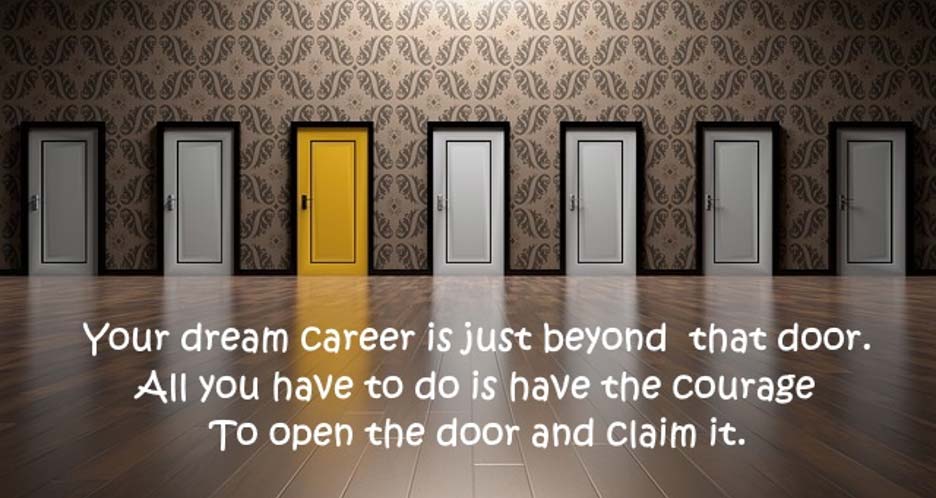
A room with seven doors, one of which is bright yellow, with the following text superimposted: Your dream career is just behond that door. All you have to do is have the courage to open the door and claim it.

Identify

A company’s culture reflects their values, practices, and beliefs. Research to determine if the culture of a company you are looking at is a good fit for you, starting with the company’s website. Look at the mission statement, the section that describes the company, and why it was founded. Review recent articles or press releases. Research social media for employee and customer comments. When looking at some of the comments by employees, former employees, or customers, bear in mind that not everything you read is true. Look at the leadership team, and read their biographies, noting in particular their education, work experience, and background. The leadership team determines the culture in mid-to smaller-size companies.

Lastly, is the company large or small, established or a start-up? There are pros and cons to each one. It comes down to your personality, goals, and what you are looking for in a company. If you are a structured individual, want to focus on a specific area, and value a fairly predictable career path with stability, a large company may be a better match. If you are entrepreneurial and adventurous, consider a smaller company or even a start-up, especially if there is an opportunity for ownership.

It will take a lot of work and research to go through these five steps. But by putting that work in now, you will set yourself up for a happier, more successful and more fulfilling career.

Read More